Oil volatility is here to stay Part 1 - A short history of oil prices
Even if the present war were to meaningfully end and traffic through the Strait of Hormuz be restored to prewar levels, oil would still be doomed to a future of increasingly unpredictable costs.


Trump’s on-again, off-again war with Iran seems to be back on. This week’s unsurprising end of the fragile ceasefire has, once again, introduced fresh volatility into oil markets as traders react to the end of what limited shipping was leaving the Strait of Hormuz. The economy’s latest bout of energy volatility is, if anything, increasingly become the norm for oil and based on present conditions this new normal is likely to be getting worse. Even if the present war were to meaningfully end and traffic through the Strait of Hormuz be restored to prewar levels, oil would still be doomed to a future of increasingly unpredictable costs. This new, structural volatility is all thanks to the proven geopolitical instability of the world’s largest source of usable crude oil, the damage done by this conflict and the war between Russia and Ukraine to the oil industry’s global production capacity, and the pressure being exerted by the increasingly stiff competition coming from surging renewable energy adoption.
In this four-part essay, I will break down the causes of this new volatility. In this opening segment, I will explain the larger realities of the world of oil since the Oil Bust of 1985 and how these conditions help us understand why our present circumstances are different from past oil gluts and droughts. Part 2 will discuss the clear geopolitical instabilities which are likely to persist and escalate even if Donald Trump were to leave office tomorrow. Part 3 will dig more into the damage done to physical infrastructure around the world, with a particular focus on the Gulf and Russia, the depletion of strategic and industry reserves, and why this is likely to tie up substantial quantities of capital expenditure for the foreseeable future. Part 4 will finish on what is, hopefully, an optimistic note by discussing how renewable energy’s rise is likely coming at oil’s expense and is exacerbating these likely to be volatile conditions.
With that said, it is time to jump back into oil’s recent history. Our modern oil market truly began in the late 1980s when the 1986 Oil Bust and standardization of oil futures trading stabilized the now-increased supplies of oil flowing into oil markets. This period also saw OPEC shift into its new role as a stabilizer of global prices through its significant swing production capacity and as a new, reliable source of liquid capital. The result was a prolonged period of low, stable real oil prices with reduced volatility. The only major surges in cost and price volatility prior to the lead-up to the 2008 financial crisis were due to the 1991 Persian Gulf War and the early 2000s recession triggered by the bursting of the Tech Bubble as shown in the charts below.
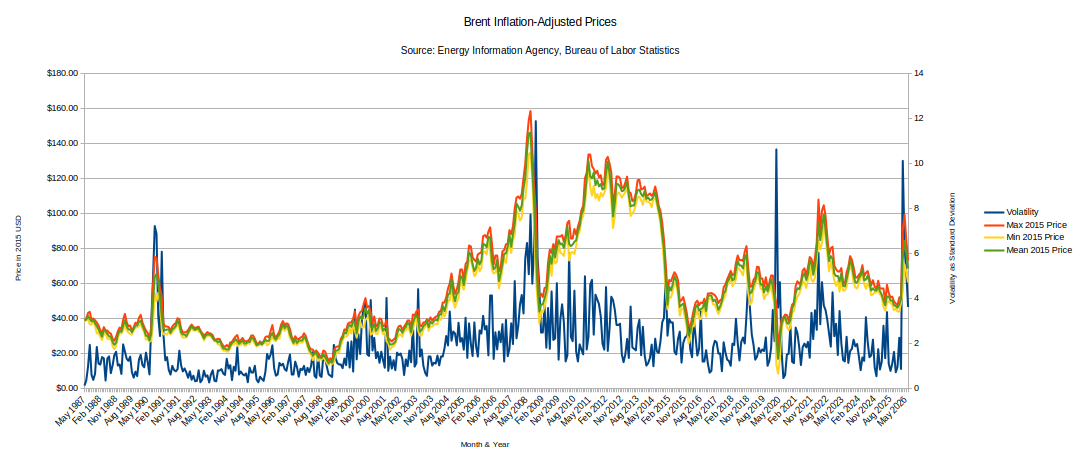
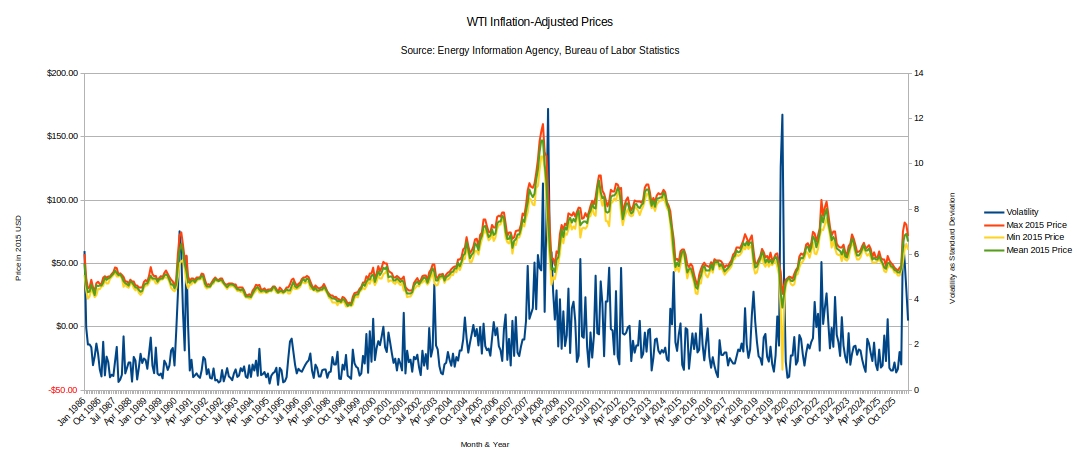
The relative stability of this market came to an end in the wake of the pre-2008 Financial Crisis oil price hike. The economic contraction and reduced demand for energy which followed led to a brief slump in prices before the real cost escalated again. What followed as a prolonged period of high real prices, which created a limiter on economic growth, as the United States poured substantial investment in expanding domestic production through hydraulic fracturing or fracking. These developments were met with some degree of alarm by OPEC’s members who responded with a price war, reflected in the period’s volatility, where they sought to use their lower break-even production costs to force US fracking producers out of the market. This period of high real costs began stabilizing and dropping in 2014 and 2015 when American production reached critical mass and ended after the United States ended its longtime ban on exporting domestically-produced oil.
These episodes illustrate some key tendencies that are critical for understanding how the oil market used to operate. Periods of glut and stable supply, as was the case for the late 1980s and 1990s, keep costs low, stable, and predictable. Any significant contraction in supply or disruption to the reliability of supply, as was the case with the fracking price wars of the 2010s, results in volatile prices and increased real value. These uncertainties and heightened costs impose two mutually reinforcing burdens on all economic actors that encourage hedging against danger instead of investing in potential opportunities or improving production. For lower-margin operators, these added costs are the difference between solvency and bankruptcy.
These past conditions also help explain why, so far, the present oil shock’s impact has been somewhat delayed though ultimately cannot be denied and are already manifesting. The greatest post-2008 shock to oil prices, prior to the present day, was the negative 2020 shock. The global lockdown to combat COVID-19 saw economic activities which depend on oil dry up and the demand for oil crashed. In July 2020, the real cost of West Texas Intermediate, or WTI, crude fell fell into the negative and Brent crude fell close to zero shortly after a brief price war caused by OPEC+’s members jockeying for dwindling market share.
This crash created a long-term glut for global oil supplies. The post-COVID glut took a serious hit following Putin’s 2022 invasion of Ukraine and has dried up completely thanks to the new oil shock. American fracking has also reached its limits and while exploration continues, it still takes months to years before new production fields are fully online assuming the reserves uncovered a sufficient to be worth exploiting. What we now face is the ultimate stress test for an industry that, until now, operated under the assumptions that they’d always be in demand, that Gulf oil supplies and new prospects would always be available, and these realities gave markets enough durability to withstand any shocks or periods of price instability. It also appears the causes of these production limitations are only likely to get worse and not better.


