Oil volatility is here to stay Part 4 - The electrotech revolution


As has been established in the first three parts of this series, the oil industry is facing something of a perfect storm of demand and capacity destruction. The combination of war and oil shock have entrenched a growing trend towards volatility in oil markets which are currently destabilizing oil prices. These present conditions, in conjunction with the actual sticker shock for everything from jet fuel to rising diesel prices, are all encouraging consumers worldwide to seek alternatives to carbon-based fuel sources.
On their own, such conditions are quite comparable to the energy crisis of the 1970s, the last major challenge that faced the oil industry. Historically, this challenge was answered by opening up new fields, which could be justified by now-higher break-even points.i Alternatives like solar, wind, and hydrogen foundered due to the immaturity of these technologies while the expansion of coal and nuclear energy decreased oil’s market share while failing to really threaten its economic position.ii Now, as anyone who has perused the headlines for energy can tell you, is very different as renewable energy sets record low, “offensively cheap” prices and battery performance soars. Oil doesn’t just face a new competitor, it is actively being made obsolete.
Nothing better demonstrates this than the rise of electric vehicles. If there has ever been one technology that cemented oil’s central role in the modern world, it is the internal combustion engine. This technology motorized global transportation at an unprecedented level, as shown by the most recent data from the International Energy Agency showing global demand for transportation fuel by type in the following chart. The inability of 1970s renewables, hydrogen, or nuclear-sourced electricity to compete meaningfully with this reality is a big part of why the oil industry was able to rebound and recover their position.
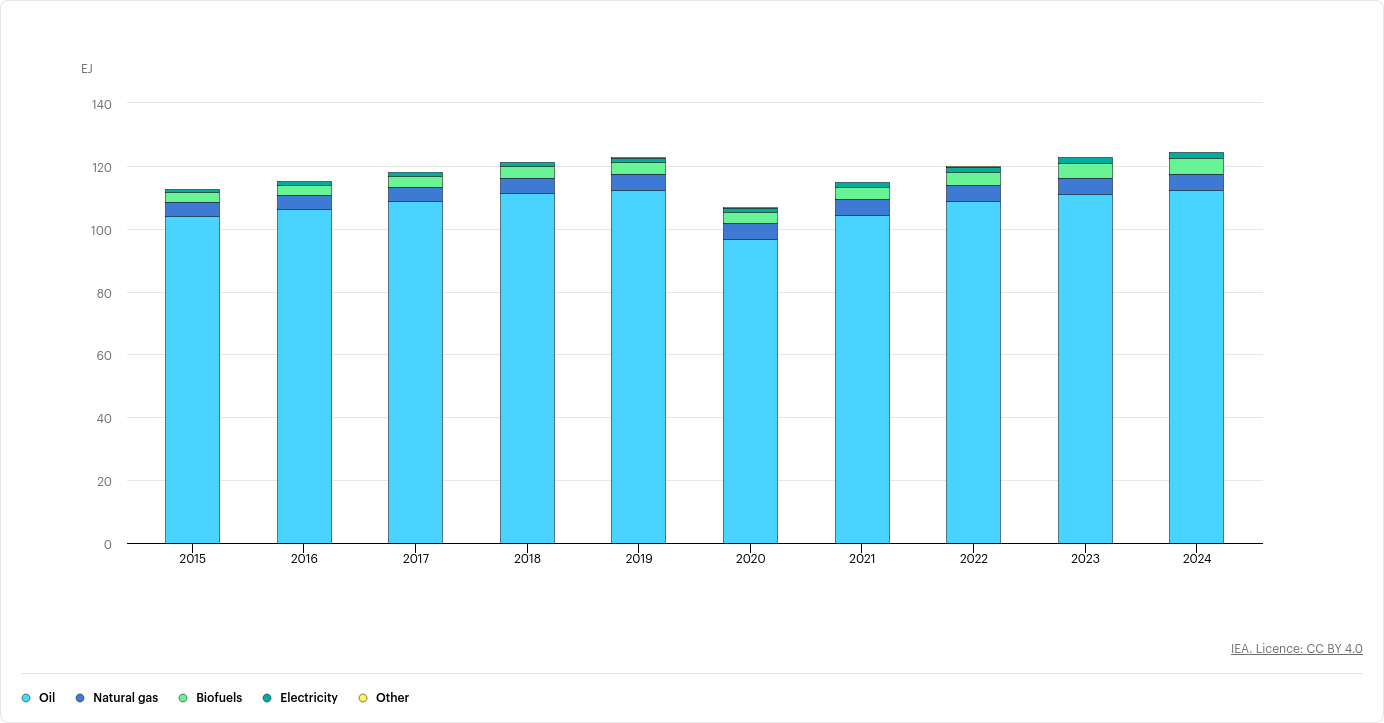
Electric vehicles have put an end to this reality. As I’ve discussed previously on this blog, electrotech is already advancing at leaps and bounds with electric vehicles firmly leading the charge. Even the oft-cited problem of long recharging times is being solved, as shown by Sunwoda’s new EV battery that can go from 10% to 70% charge for its 435 mile range in five minutes and hit 97% in only nine. Such batteries are also soundly beating the median US gas car range of 413 miles and are only climbing, showing even the energy density advantage once long-enjoyed by oil has now been soundly bested.
Even without these recent advances, electric vehicles had already surged by 20% from 2024 to 2025 to a record of twenty million vehicles sold thanks to their flexible energy requirements and lower operating costs. The increasing maturity of this technology, just as oil is becoming more volatile and unreliable, has only encouraged further adoption. As of August 2026, global EV sales reached new highs and are on track to represent 30% of vehicle sales by the year’s end, a 50% jump in year over year growth. EV sales in Australia are such good business that they may have kept the Iranian oil shock from shoving Australia into a recession. Researchers at the Salata Institute for Climate and Sustainability even argue that present trends suggest nearly a third of all vehicle sales in the United States will be electric by 2030 despite Donald Trump’s anti-EV and pro-carbon policies.
In short, the technological package of better batteries and dirt-cheap renewable energy is pushing oil out of one of its long-unchallenged strongholds and this pattern is not unique to electric vehicles. Fully electric container ships are now sailing the rivers and coasts of China while all-electric, short-haul aircraft are being tested over the skies of New York and western Scotland. These modest steps into oil-dominated fields cannot compete over long ranges with jet and bunker fueled vessels yet, but such technologies show similar potential to other electric vehicles while benefiting from the same stability and fuel cost advantages as other technologies that utilize on renewable energy. Even modern plastics, one of oil’s great marvels, are experiencing a surge in new, non-petroleum options.
So what does this technological revolution mean for the oil industry? Currently, many of the big players like Saudi ARAMCO and BP are posting record profits thanks to the heightened price of oil. There is a certain perversity that such a crisis is a moment of great benefit for the industry’s players despite the risks it poses to their overall long-term prognosis. These windfalls may wind up being more a temporary lifeline than a long-term solution to their larger problems and the reasons for this are explained in a January 29, 2026 article in Science by Joshua Lappen and Emily Grubert titled, “Fossil energy minimum viable scale.”
According to Lappen and Grubert, every form of fossil fuel production has a minimum viable scale. What this means is they have to be producing enough fossil fuels to justify their larger costs of operation. If operations dip below that threshold, then the facilities in question cease to be sustainable and continued use will impose mounting material, financial, and personnel costs. In the case of oil refineries, this threshold is hit when these facilities are only operating at 65-70% of overall capacity. Any operations below this point increase the risk of inefficiency and unsafe conditions which produce their own added costs, downtime, and capacity limitations.
This minimum viability problem means that as the price of oil becomes more volatile and demand declines, further pressure will be placed on remaining consumers to make up for the loss of customers. Customers forced to bear this burden will, as is already happening, seek alternatives to oil-based devices and further cut overall demand. Declining demand, particularly if there is more concentrated impact on specific products like diesel, will force oil production cutbacks and decreased capacity utilization in upstream facilities. The longer this dynamic persists, the greater the odds become that some facilities will cease to function properly or reliably which will further constrict the overall supply, increase the price at the pump, and create further instability.
There is, in other words, no way out for the oil industry. A Trump-Putin-Persian Gulf Axis of Oil could have potentially slowed the arrival of these new conditions but that would’ve required careful coordination and for all three players to not be wrapped up in imperial adventures which are currently lighting the oil industry on fire. One could also argue these same pressures may have whetted their appetites for empire-building despite the clearly detrimental and foreseeable consequences, but that question of motivation is mostly academic when set against the realities of our present conditions. It is a simple fact that oil, as an industry, is facing an inescapable siege that is already slowly but surely strangling it.
This stark fact is why no amount of last-minute rescue operations like the ill-conceived re-openings of the North Sea, the California coast, or Venezuela will save the day. Even if they could turn things around, oil’s big players would still need years to do the job that renewables are doing in weeks and months. No matter what the oil industry does, they now face a future where easy supplies are scarce, prices are increasingly unstable, and continued demand destruction is assured. The future, simply put, is electric and there is nothing the oil industry or their political allies can do to change that. The only questions left are how quickly the transition off petroleum can be implemented and how to best remove the political obstacles which are standing in the way.
iDaniel Yergin, The Price: The Epic Quest for Oil, Money & Power, Free Press (New York, NY: 2009), 701-728;
iiJohn Perlin, Let it Shine: The 6,000-Year Story of Solar Energy, New World Library (Novato: 2022), 351-370; Daniel Yergin, The Quest: Energy, Security, and the Remaking of the Modern World, Penguin (New York, NY: 2012), 527-551


