Oil volatility is here to stay Part 2 - A question of geopolitics
War with Iran has created new geopolitical instabilities which conspire to keep the Persian Gulf from returning to its old role as the world’s swing producer and limit the overall capacity of the global oil industry.


There is little debate the present volatility experienced in the oil market is driven by geopolitical factors. Donald Trump’s illegal war against Iran is the unquestioned cause of the closing of the Strait of Hormuz and the subsequent, highly predictable loss of 20% of the world’s oil and natural gas supply along with similarly concerning quantities of fertilizer, helium, plastics, and aluminum. On a more fundamental level, this conflict can be best chalked up to a combination of American and Israeli hubris offering a seemingly easy solution to what has been, for both countries, the intractable strategic problem known as the Islamic Republic.
Unfortunately for oil markets and everyone who uses energy, the seemingly easy solution of trying to bomb a major, industrialized fossil fuel exporter back to the stone age failed miserably. In the process, this has created new geopolitical instabilities which conspire to keep the Persian Gulf from returning to its old role as the world’s swing producer and limit the overall capacity of the global oil industry. At time of writing, the two main destabilizing geopolitical forces now dominating the Persian Gulf and its place in oil markets are the UAE’s abrupt exit from OPEC and America’s clearly declining influence in the region.
The breakdown of OPEC is the most important place to start for understanding the challenges facing the oil industry because they are likely to be the farthest-reaching. The main reason why lies in OPEC’s place in the global economy. Ever since the 1970s, OPEC’s vast oil wealth has allowed the bloc to serve as the world’s swing producer. This made them the stabilizer for oil markets who could increase production in the face of supply shocks and institute cuts in the face of gluts. Regulating production and prices on a cartel level was achieved through complex negotiations to determine how much oil each member was allowed to produce in any given year.
With how critical oil is to OPEC’s members, these production quotas and their underlying costs are a major point of tension, which once erupted into economic conflict in the Oil War of 19771, as they dictate the economic and fiscal capacities of their respective economies. In the 2014, OPEC’s members used their production power and low breakeven points to undercut the American shale oil industry, which had higher costs of production, and drive a potential competitor out of the market. In short, OPEC’s members are very familiar with how shifts in the price of oil impact global economics as well as their own power and fortunes.
The UAE’s April exit from the cartel suggests they are about to leave those quotas in the dust and set production based on what they see as best for their needs. The Emirates do have good reason to pursue an overproduction strategy even though this would come at the rest of OPEC’s expense. The UAE has some of the lowest breakeven prices for oil in the world with an average cost of $49.95 as of the end of 2025. Saudi Arabia’s breakeven point, by contrast, was $90.93 in 2025 and has been rising steadily since the COVID-19 pandemic. The UAE, in other words, profits at a much lower oil price than the Saudis, whose preferences have long set the tone in OPEC, and potentially expand their market share by undercutting the rest of the bloc’s price. They also are quite aware of how politically destabilizing this could be for their former fellow OPEC members.
Nothing better spelled out these realities than an interview given by Emirati Energy Minister Suhail al Mazroui, just prior to the UAE’s exit from the bloc. In it, he boldy asserted, “This has nothing to do with any of our brothers or friends within the group”, and that the decision was a “pure policy change” regardless of details like the ongoing war or the optics of the UAE abandoning OPEC while fighting alongside fellow OPEC members like Saudi Arabia. His further assertion that the move would provide the UAE with the means to effectively respond to changing market conditions was met with the consensus emerging from analysts that the departure of OPEC’s third largest producer poses a major risk to OPEC’s viability and of greater postwar oil market volatility. Al Mazroui also suggested in his CNBC interview that production increases were already baked in before their departure when he asserted the UAE remained committed to their 5 million barrel per day by 2027 production target. Reaching such a volume would represent an 85% increase from the UAE’s 2.7 million barrel per day 2024 output. On July 10th, they nearly reached that level of production when their total output surged to an estimated 4.1 million barrels per day.
These words and actions show the UAE is more than willing to risk a price war with their former compatriots even though past price wars, like the Oil War of 1977 which undermined the Iranian economy and helped set off the Iranian Revolution,2 risk destabilizing the economies of other petrostates in the region. The UAE’s drive to do this is somewhat understandable as they, like the other Gulf monarchies, have long sought to diversify their economies away from fossil fuel exports. Their ability to export around the Strait of Hormuz gives them a further advantage over the other Gulf powers while disincentivizing seeking a solution to the Strait of Hormuz problem. Such moves further foreshadow greater divisions between OPEC’s Gulf members, divisions which are likely to play out as further oil market volatility.
This brings the conversation to the question of America’s place in the region. The US position in the region, since President Carter’s 1980 State of the Union when he announced that American military power would guarantee the safe passage of oil through the Persian Gulf, has been one of guaranteeing this passage. This status was reinforced by the 1991 Gulf War when America’s big stick effectively proved itself as capable of making good on this promise while also, critically, restraining Israel from taking military action. The spice, to paraphrase Dune, kept flowing and as long as this remained true then America’s role remained indispensable and oil markets could rest easy.
The last five months have been a brutal refutation of these taken for granted realities. Oil markets have averted catastrophe thanks to American overproduction and the world’s strategic oil reserves, with China’s playing a particularly critical role in stabilizing East Asia, though warnings that reserves and inventories are hitting record lows suggest this solution may be running on fumes. Nothing has better shown the instability of this situation than the repeated drops in oil prices which have followed promises of the Strait’s re-opening despite the clear evidence that such proclamations are mostly baseless. As shown in the chart below, energy exports from the Gulf have failed to come close to their prewar levels and the main cause of bumps in traffic through the Strait have been imports of agricultural goods.
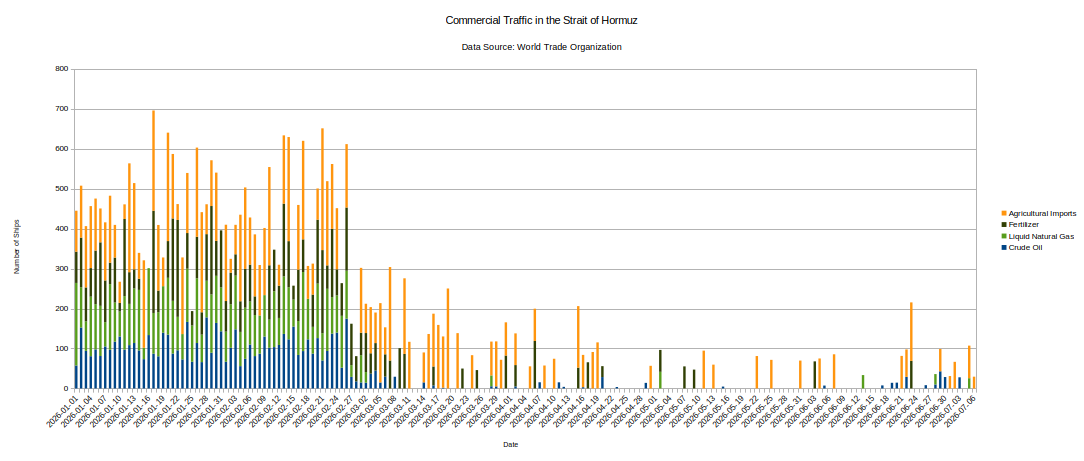
This failure to restore the prewar status quo or restrain the Israeli government from military action in Lebanon despite repeated US promises to do so have shown the limits of American power in painful terms. These limits are further reinforced by data showing that Iran’s drone campaign, along with devastating energy infrastructure in the region, has inflicted lasting harm to American military infrastructure in the region. The first month of conflict rendered thirteen key US military installations in the Gulf effectively uninhabitable. By June 1st, satellite analysis cited by the BBC showed approximately 28 US military sites across the region were heavily damaged. These losses represent a genuine reduction in American military capabilities which are likely to be further eroded by the resumed fighting. Politically, the harm runs much deeper. American military power, which was supposed to keep Iran in check and protect US allies in the region, has failed spectacularly at doing either while casting doubt on its long-term prospects. The Carter Doctrine’s core assumptions of American military dominance have been dramatically, potentially fatally, undermined in ways that the Gulf powers cannot ignore.
In practical terms, this means American leverage over regional powers is already greatly reduced compared to the pre-war status quo, will continue to decline the longer the US fails to end the conflict militarily, and those hostile to American power in the region are likely quite emboldened by the Yankee Colossus’ latest pratfall and considering risks they previously would’ve dismissed. Such conditions, while insufficient on their own to force the United States from the Persian Gulf, are likely to create a situation where an American retreat from the Middle East goes from unthinkable to openly discussed and, potentially, an option on the table. American planners may be loathe to consider such a possibility but the US position in the Middle East will have to re-orient to these new realities before footage of the last helicopter out of Qatar drops.
These geopolitical realities are made worse by the very real, material realities of the state of energy infrastructure in the Middle East and the Russian Federation. This damage, as will be discussed in Part 3, represents a long-term problem for the oil industry which will take time and resources to solve. Oil’s big players may also, as will be examined further in Part 4, lack the time or means to enact any solutions that would prolong the industry’s life or reduce the volatility of present conditions.
1Ryan C. Smith, The Real Oil Shock: How Oil Transformed Money, Debt, and Finance, Palgrave MacMillan, (London: 2022), 185; Andrew Scott Cooper, The Oil Kings: How the US, Iran, and Saudi Arabia Changes the Balance of Power in the Middle East, Simon & Schuster, (New York: 2011), 371-383
2Andrew Scott Cooper, The Oil Kings: How the US, Iran, and Saudi Arabia Changed the Balance of Power in the Middle East, Simon & Schuster (New York, NY: 2011), 359-368


