Oil volatility is here to stay Part 3 - Hazards of war


If the breakdown of the prewar status quo for the Persian Gulf is the geopolitical crisis which guarantees a less stable oil market, then the damage done by war to Persian Gulf and Russian energy infrastructure is the material crisis which will limit future oil production. This destruction will also require significant investment in terms of capital, specialized labor, and manufacturing capacity by these oil exporters to repair the damage done. These conditions of reduced capacity will be further exacerbated by the demand for oil to replenish depleted inventories and strategic reserves, placing further constraints on an already-limited supply.
In short, the oil industry would still be facing a major structural shortfall in the very near future even if the war were to meaningfully cease today. Based on conditions at time of writing, this shortfall will likely persist for at least a year following any cessation of hostilities in the Gulf and Russia as infrastructure is repaired, transportation systems are restored to prewar levels, and market actors are convinced the region is once again safe and profitable. This shortfall also lacks any easy fixes, like building alternative transportation routes around the Strait of Hormuz or increasing production in other regions, which means the global supply of oil will remain tight, heavily demanded, and always fluctuating.
The Hormuz crisis is, without question, the main driver of global production shortfalls. Much has been said of the 20% of global oil and natural gas that flows through the Strait already and what this coverage tends to emphasize is the role of the war in halting the flow of shipping. What more focused reporting shows is that infrastructural and long-term damage to the region’s production and distribution systems is likely to hamper future productivity and constrict energy supplies.
One of the best estimates of the total costs of damage was produced by Rystad Energy shortly after the first major round of March fighting ended. In it, they estimated approximately $58 billion in damage had been inflicted on the region’s energy infrastructure, the bulk of which was done to downstream assets like refineries and facilities used for producing finished petroleum products. At the time, they estimated the bulk of the $40 billion in repairs were needed for replacing equipment, key materials, and rebuilding the affected facilities. As Rystad observed back in April, the main bottleneck for reconstruction was not capital but rather access to the needed equipment and skilled personnel, both of which exist in limited supply. They also noted the repair timelines were mostly measured in months and years rather than days and weeks, suggesting the production limitations are likely to persist rather than cease with the end of fighting.
These concerns were further buttressed by IEA Executive Director Fatih Birol’s late March remarks that the war’s damage was unleashing the worst energy crisis in history. One of his main concerns was how around forty Middle East energy assets had been severely damaged in the war. One of the most spectacular such examples was the mid-March missile strike on QatarEnergy’s sole liquid natural gas refinery at Ras Laffan, the world’s largest such facility. QatarEnergy personnel estimated the repairs to the supplier for around a fifth of the world’s liquid natural gas could take between three and five years to complete. Such repairs will also be forced to compete with the demands of other, similar sites throughout the Gulf.
These estimates do not, of course, take into account additional damage which has been inflicted during the latest round of increased fighting. Iranian strategy has specifically emphasizes either attacking or exerting pressure on energy infrastructure throughout the region, confident the escalating pain this approach will inflict is greater than the United States or their Gulf allies can endure. Tit for tat retaliation against power and water infrastructure has spread the misery of the conflict around while also multiplying postwar reconstruction demands. Houthi intervention has also brought the risk of harm to Red Sea ports and shipping. Even the Suez Canal, which as was discussed in Part 2 is already at its limits, is no longer safe as shown by a recent drone strike on liquid natural gas freighters docked in the Egyptian port of Damietta at the mouth of the Nile River.
This all means the earlier estimates of damage, pace of reconstruction, and cost of repair will need to be adjusted significantly upwards of Rystad’s April $58 billion once the dust has sufficiently settled. These reconstruction timelines also depend on the war actually ending in a definitive fashion. Unfortunately, Donald Trump’s proven inability to understand the problem he has created, stick to the terms of his ceasefires, and his obvious fear of looking weak by capitulating to Iran all conspire to thwart a genuine end to the fighting. This combination of growing demand for limited expertise and increasing damage will exert increasing pressure on the Persian Gulf’s ability to reconstruct its energy facilities. In short, the longer the war goes on, the longer it will take to clean up after it.
A similar story is also playing out for many of the same reasons in Russia. Since late 2025, Ukraine has been escalating a long-range drone war against Russian oil and gas facilities which has targeted every aspect of energy production. The damage has become so severe that Russia, a major petroleum exporter, is now facing widespread fuel shortages while delegates to the June 3rd St. Petersburg International Economic Forum were greeted by oily plumes of smoke from a nearby drone-struck refinery. Russian oil production faces an unprecedented crisis which, like that of the Persian Gulf, is likely to need years to repair, access to extensive specialized knowledge and equipment, and a cessation of hostilities which also seems to be nowhere in sight.
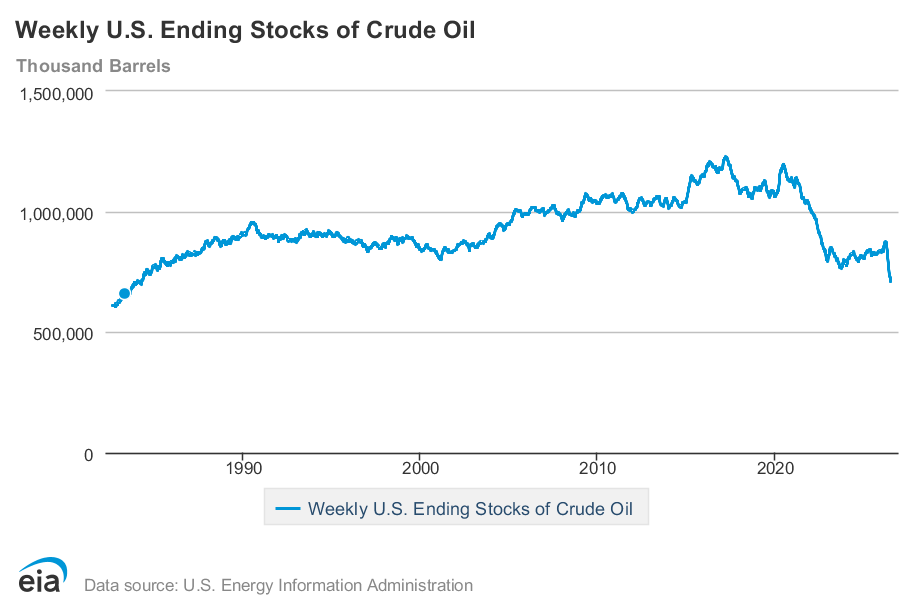
The reductions in production have, so far, been mitigated somewhat by a dramatic dropoff in the world’s oil inventories. This protective measure which, at time of writing, has prevented a repeat of the sharp shock of 1973 at the cost of future capacity to repeat the same performance. Nothing better illustrates how sharp this blow has been like the state of US inventories, excluding the strategic petroleum reserve, as shown in the chart produced by the EIA below. As per the EIA, US oil stocks are at their lowest level since April 13th, 1984.
Similar trends have held true for oil reserves around the world. Japan’s reserves have been so heavily tapped that the Prime Minister ruled out tapping the reserves in May. Their government feared such a release would diminish their ability to meet any future any energy shocks. Europe, similarly, has been steadily draining their reserves and are also experiencing record low levels. China, so far, has averted energy catastrophe by tapping their substantial petroleum reserve, though recent reports of manufacturing slowdowns suggest this solution may be reaching its limits.
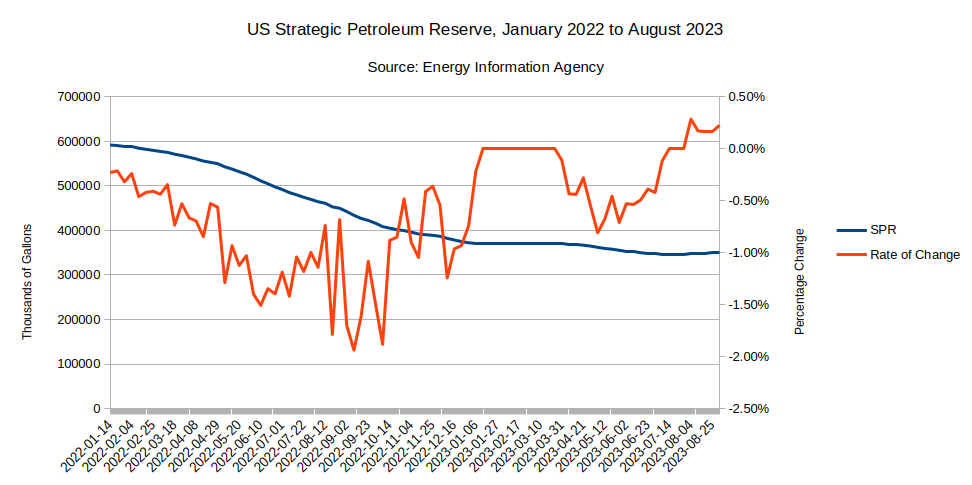
If we use the US Strategic Petroleum Reserve as a proxy for the world’s reserves, we get a clearer picture of the challenge facing the world’s oil inventories. The first chart shows the 2022 oil shock that was initiated by Putin’s invasion of Ukraine. As shown here, the rate of decline reached its peak in September 2022 before eventually reversing and returning to a steady state of increase. This dynamic reflects how global energy reacted to the 2022 shock, particularly how the oil industry had sufficient slack capacity to recover from the war.
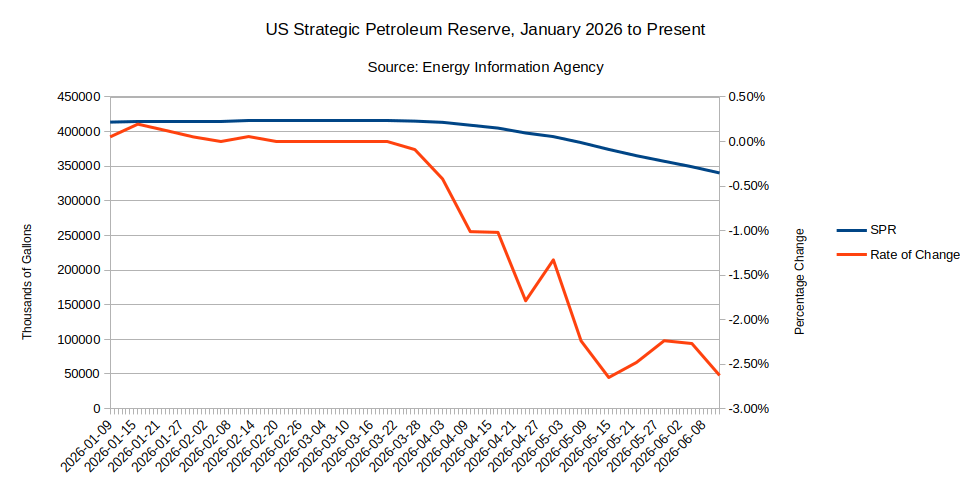
The same has not been true of the SPR during the course of the Iran War. As shown in the chart below, the SPR has never stabilized or meaningfully reversed. It also, in stark contrast to the 2022 shock, has declined much faster. The SPR’s inability to recover mirrors a similar conundrum facing the reserve supplies which hold up the oil industry. Demand simply outstrips present supply and bridging that gap will require a greater market intervention than the industry is presently capable of mustering.
The problem this presents for the oil industry and oil as an energy system are twofold. First, and foremost, is the state of the world’s oil reserves will be an additional source of pressure on the world’s oil supplies and increase the overall price. Strategic reserves have, understandably, signaled their desire to restore their stocks as soon as the crisis ends and building back up from record lows will require both time and significant quantities of oil to be purchased.
The second problem posed by the historic depletion of oil inventories is how it decreases available options for facing future energy shocks. So far, our present energy crisis’ impact has been blunted by the use of strategic reserves and inventory supplies. Future energy shocks, which are more likely thanks to the geopolitical instabilities now unleashed by Trump’s war and the damage done to infrastructure, will face depleted means for addressing the damage done. Policymakers will likely face the same challenge as the Japanese government and be forced to decide whether they should hold back reserves during a time of energy scarcity to protect future inventories or release and reduce immediate pain. The result will be a market with much narrower margins for error where, in the words of Rystad Energy oil & gas researcher Olga Savenkova, “Crises are now becoming part of the normal.”
If oil, coal, and natural gas were still the unchallenged energy sources for our economy then one could argue that we would all be forced to grin and bear it for the duration. Unfortunately for the oil industry, this is most certainly not the case. As will be covered in more detail in Part 4, the oil industry is not just facing a sharp limitation to its production capacity. It is also watching demand for their increasingly volatile, expensive products decline as renewable energy and electric vehicles reach maturity. This demand destruction will also hamper the industry’s ability to operate, further reducing their ability to respond, expand production, or adapt. The oil industry is at the precipice of a truly vicious cycle which could spell doom for the industry as a whole and it is all thanks to the industry getting everything they could ever want from a US White House.


